One small job becomes a list during the call.
Capture the full task list so a callback is based on the whole visit.
CALLMINDED FOR HANDYMAN SERVICES
One call. A clearer list of small jobs.
Choose what the receptionist asks, what it can answer and what happens next. Explore a flow shaped around handyman services.
Guided setup included. We help you approve and test your flow before the trial starts.
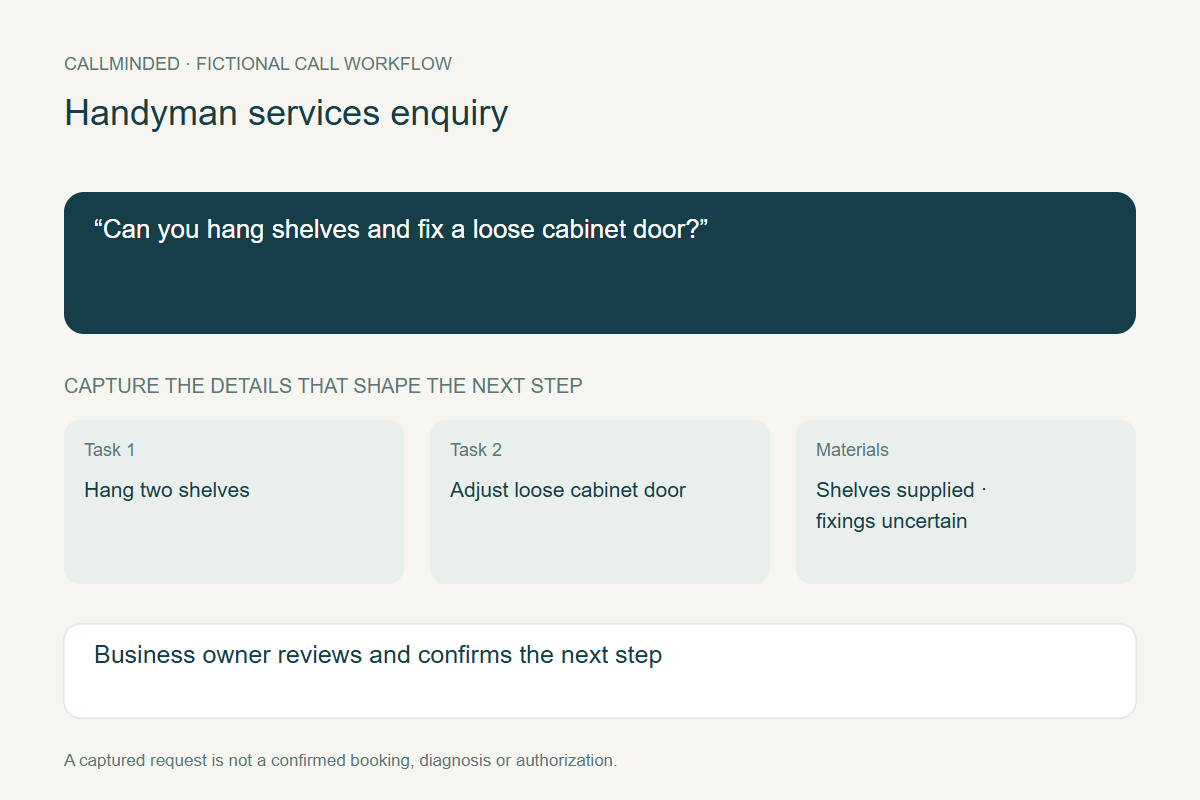
“Can you hang shelves and fix a loose cabinet door?”
Business owner reviews and confirms.
Dashboard handoff · pilotFictional example. Your business sets the questions and limits.
WHY THE DETAILS MATTER
Capture the full task list so a callback is based on the whole visit.
Ask what the caller already has and where the work is located.
Use your exclusions so the receptionist does not accept work outside your services.
WRITTEN CALL EXAMPLE · FICTIONAL DETAILS
See the caller’s request and the information prepared for your business owner. The brief includes details collected beyond this short excerpt.
“Can you hang shelves and fix a loose cabinet door?”
“Do you already have the shelves and mounting parts?”
“The shelves, yes. I’m not sure about the fixings.”
Close by confirming contact details and explaining that staff will review the request. This is an editorial example, not a customer recording. Any service prices are fictional business-menu examples, not CallMinded plan prices.
SAMPLE DASHBOARD REQUEST
Review suitability, materials and likely visit length before calling back.
Current pilot handoff is in the dashboard. No calendar, email or SMS action is triggered.
YOUR BUSINESS SETS THE RULES
These are example choices for a setup discussion. You approve the questions, answers and handoff, then review test calls before activation.
Explore business controls →Explain approved minimum-visit policies, offered tasks and materials arrangements.
The owner decides whether tasks are suitable and how long they take. No acceptance of regulated or excluded work by assumption.
THE NEXT SYSTEM IN YOUR WORKFLOW
A future job-management connection should preserve multiple tasks inside one enquiry rather than creating unrelated bookings.
CRM and scheduling connections are planned. Tell us the app you use so we can assess the connection, required fields and approval rules.
See the integration approach →Collect the agreed details in the pilot dashboard.
Match the customer, service and your approval rules.
Save the request in your app and show anything that needs attention.
A PRACTICAL START
Choose the flow, approve your business facts and review test calls together. Carrier forwarding and fallback are verified before activation.
EDITORIAL REVIEW · OCTOBER 14, 2026
Start with the request in the example above: small-job list · visit estimate. The goal is a brief your business owner can act on, with the original caller details preserved. These are proposed setup choices, not active settings or measured customer outcomes.
Ask only for details needed to handle the enquiry. Confirm the caller’s name and callback number, accept corrections, and leave unknown information visible. Avoid making someone guess details they do not have. Your business approves the questions and the fallback for requests outside your services.
Explain approved minimum-visit policies, offered tasks and materials arrangements. Keep the approved wording, currency, inclusions and conditions together. A starting fee must not become a final quote when the work has not been assessed.
The owner decides whether tasks are suitable and how long they take. No acceptance of regulated or excluded work by assumption. An urgency flag does not establish availability. A requested day or time is not a booking, and a saved brief is not authorization to perform the work.
Review missing details, corrections, staff follow-up and the eventual outcome. Count a successful conversation separately from a confirmed appointment or sale. Use your own trial records to decide whether the flow helps; no conversion increase is promised.
Use the receptionist trial scorecard · Understand requests versus confirmed bookings · Evaluate answers and uncertainty
Create your account, verify your email and prepare your business information. Guided setup and forwarding checks come before activation. The free trial lasts 14 days or 50 AI conversation minutes, whichever comes first, and starts when your receptionist is ready. No credit card is required; answering pauses at the limit, with no automatic extra-minute charges.
Start my free trial ↗See the signup and setup steps · Review current pricing and trial terms
These workflows are our design interpretation of industry documentation. They are not performance claims, endorsements or proof of a CallMinded integration. Reviewed September 29, 2026.
A FEW GOOD QUESTIONS
Yes. The example collects separate tasks in one request so the owner can assess the visit as a whole.
Use explicit exclusions in the approved business information. Unclear requests should remain for review.
YOUR NEXT STEP
Tell us where call handling gets in the way of your day.