A repair request arrives without the appliance details.
Ask what appliance needs attention and record a brand or model only if the caller knows it.
CALLMINDED FOR APPLIANCE REPAIR
Give the technician a repair enquiry with useful context.
Choose what the receptionist asks, what it can answer and what happens next. Explore a flow shaped around appliance repair.
Guided setup included. We help you approve and test your flow before the trial starts.
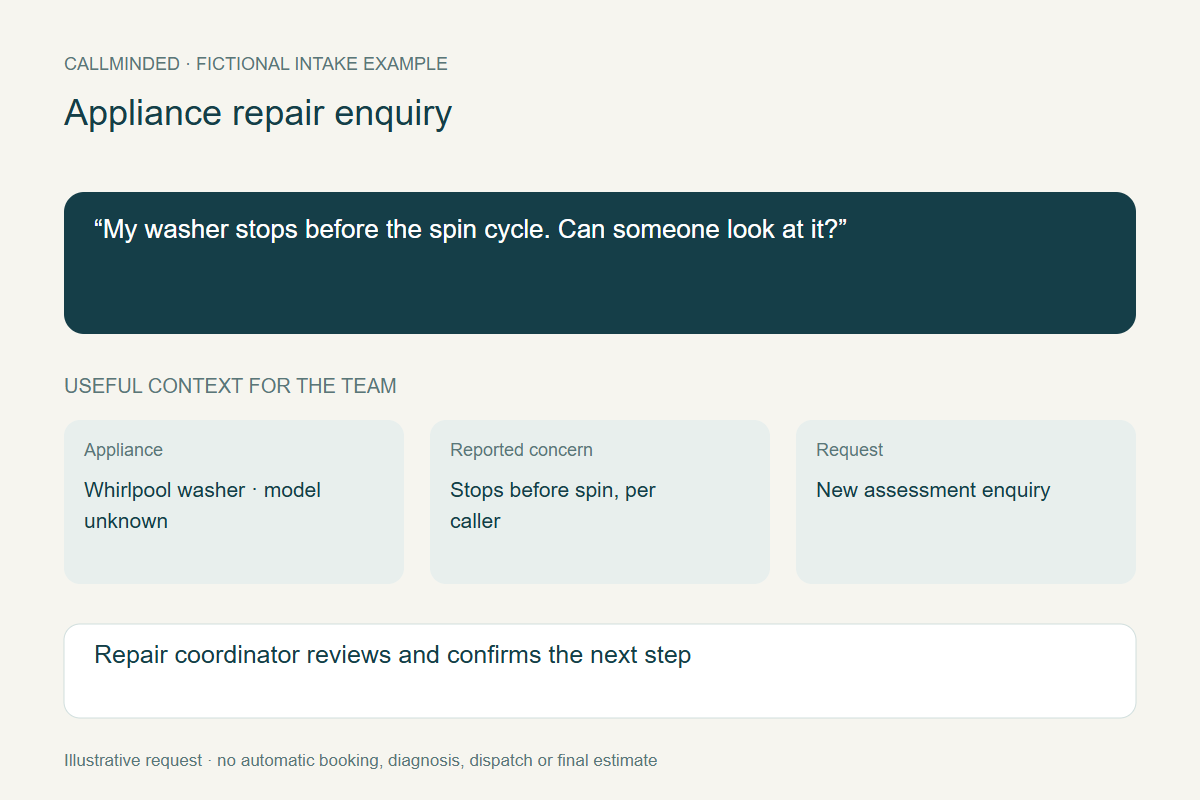
“My washer stops before the spin cycle. Can someone look at it?”
Repair coordinator reviews and confirms.
Dashboard handoff · pilotFictional example. Your business sets the questions and limits.
WHY THE DETAILS MATTER
Ask what appliance needs attention and record a brand or model only if the caller knows it.
Identify an existing repair separately so a parts-status question reaches the right person.
Keep the approved assessment fee separate from parts, labor and any repair quote.
INDUSTRY RESEARCH · REVIEWED OCTOBER 14, 2026
A caller may want a first assessment, an update on an ordered part or clarification of a service fee. These are different requests. Start by identifying whether the call relates to a new fault or an existing job, then collect the information your team needs to find the right next step. This avoids an existing customer being treated as a fresh sales lead.
Jobber’s appliance workflow documentation describes model/serial details and job notes, including parts and warranty context. Our editorial recommendation is narrower: record known appliance details and the caller’s purpose. That documentation does not establish a CallMinded connection to Jobber or prove that parts information is available during the call.
A model can help a technician prepare, but a caller may not have it. Accept unknown information and record a brand or appliance type if known. Your approved follow-up process can clarify the rest. General phone intake should not ask someone to move a heavy appliance, remove panels or perform a repair to answer a question.
Use a test where the caller corrects the brand halfway through. Review the final brief: the correction should be visible, and a reported symptom should remain the caller’s description rather than a diagnosis. An assessment request does not promise a successful repair on the first visit.
Approve exactly what the diagnostic fee covers, whether any credit toward repair applies and when staff need to assess a quote. Avoid collapsing the call-out charge into a total repair price. The trial should include a caller asking whether a warranty covers the job and whether an ordered part has arrived. Without a verified answer, both questions need staff review.
Measure whether requests include enough context for the coordinator to respond. A count of answered calls does not establish completed repairs, parts availability or revenue. Compare useful briefs and follow-up outcomes with your own baseline.
Workflow examples and recommendations are CallMinded’s editorial interpretation. External documentation does not establish missed-call rates, product integration, search volume or conversion results. Sources are linked below.
WRITTEN CALL EXAMPLE · FICTIONAL DETAILS
See the caller’s request and the information prepared for your repair coordinator. The brief includes details collected beyond this short excerpt.
“My washer stops before the spin cycle. Can someone look at it?”
“I can collect a request for the repair team. Do you know the brand, and is this a new repair enquiry?”
“It’s a Whirlpool. This is new, but I don’t know the model.”
Close by confirming contact details and explaining that staff will review the request. This is an editorial example, not a customer recording. Any service prices are fictional business-menu examples, not CallMinded plan prices.
SAMPLE DASHBOARD REQUEST
Check service coverage and assessment process, then contact the caller. Diagnosis and parts decisions follow qualified review.
Current pilot handoff is in the dashboard. No calendar, email or SMS action is triggered.
YOUR BUSINESS SETS THE RULES
These are example choices for a setup discussion. You approve the questions, answers and handoff, then review test calls before activation.
Explore business controls →Explain approved serviced appliances, coverage and diagnostic fee conditions.
No diagnosis, electrical or gas troubleshooting, warranty acceptance, parts-stock promise or confirmed repair completion.
THE NEXT SYSTEM IN YOUR WORKFLOW
Future repair software connections would need customer, appliance and job matching, with parts and return visits verified separately.
CRM and scheduling connections are planned. Tell us the app you use so we can assess the connection, required fields and approval rules.
See the integration approach →Collect the agreed details in the pilot dashboard.
Match the customer, service and your approval rules.
Save the request in your app and show anything that needs attention.
A PRACTICAL START
Choose the flow, approve your business facts and review test calls together. Carrier forwarding and fallback are verified before activation.
EDITORIAL REVIEW · OCTOBER 14, 2026
Start with the request in the example above: washer fault · model not known. The goal is a brief your repair coordinator can act on, with the original caller details preserved. These are proposed setup choices, not active settings or measured customer outcomes.
Ask only for details needed to handle the enquiry. Confirm the caller’s name and callback number, accept corrections, and leave unknown information visible. Avoid making someone guess details they do not have. Your business approves the questions and the fallback for requests outside your services.
Explain approved serviced appliances, coverage and diagnostic fee conditions. Keep the approved wording, currency, inclusions and conditions together. A starting fee must not become a final quote when the work has not been assessed.
No diagnosis, electrical or gas troubleshooting, warranty acceptance, parts-stock promise or confirmed repair completion. An urgency flag does not establish availability. A requested day or time is not a booking, and a saved brief is not authorization to perform the work.
Review missing details, corrections, staff follow-up and the eventual outcome. Count a successful conversation separately from a confirmed appointment or sale. Use your own trial records to decide whether the flow helps; no conversion increase is promised.
Use the receptionist trial scorecard · Understand requests versus confirmed bookings · Evaluate answers and uncertainty
Create your account, verify your email and prepare your business information. Guided setup and forwarding checks come before activation. The free trial lasts 14 days or 50 AI conversation minutes, whichever comes first, and starts when your receptionist is ready. No credit card is required; answering pauses at the limit, with no automatic extra-minute charges.
Start my free trial ↗See the signup and setup steps · Review current pricing and trial terms
These workflows are our design interpretation of industry documentation. They are not performance claims, endorsements or proof of a CallMinded integration. Reviewed October 14, 2026.
A FEW GOOD QUESTIONS
Only if your process requires it and they already know it. Leave unknown details for staff rather than asking the caller to move or dismantle an appliance.
Not from unverified information. Capture the existing-job question for staff; no parts-inventory connection is currently offered.
Yes, using the fee and conditions your business approves. That is not the final repair price.
YOUR NEXT STEP
Tell us where call handling gets in the way of your day.